
Use a Research Agent for Academic Work
A research agent owns a complete goal instead of assisting one step at a time. You provide the question, materials, constraints, and deliverables; it keeps searching, reading files, running code, and advancing from intermediate results in a cloud computer.
Inputs, Outputs, and Verification for Four Task Types
The Agent Executes the Complete Goal; the Researcher Validates Evidence and Methods
Decomposes tasks
For a request to map a field, it plans keywords, source scope, and extraction fields before searching and organizing.
Connects to real sources
Search results include verifiable titles, authors, publications, and source links.
Supports iteration
It inspects the first result and changes course when evidence is weak, code fails, or outputs look abnormal.
Useful across disciplines
Interdisciplinary work uses multiple vocabularies. The agent can expand common expressions across fields for the researcher to screen.
Evaluated by traceability
Check whether sources open and summaries lead to the original passage. Unverifiable content cannot enter a paper.
Works across research materials
A single task can span papers, spreadsheets, datasets, code, figures, and intermediate drafts.
Four Steps in a Research Agent Workflow
Search
Describe the question, date range, and source types. The agent generates queries, retrieves literature, and groups it by topic.
Read closely
Upload full papers and extract the question, methods, samples, conclusions, and limitations before comparing study designs.
Write
Draft from confirmed materials. Every fact and judgment must correspond to a specific source.
Revise
Select a paragraph, state the goal and content to preserve, then verify facts and citations in the revision.
Use Scientify to Keep Research Running in the Cloud Until Delivery
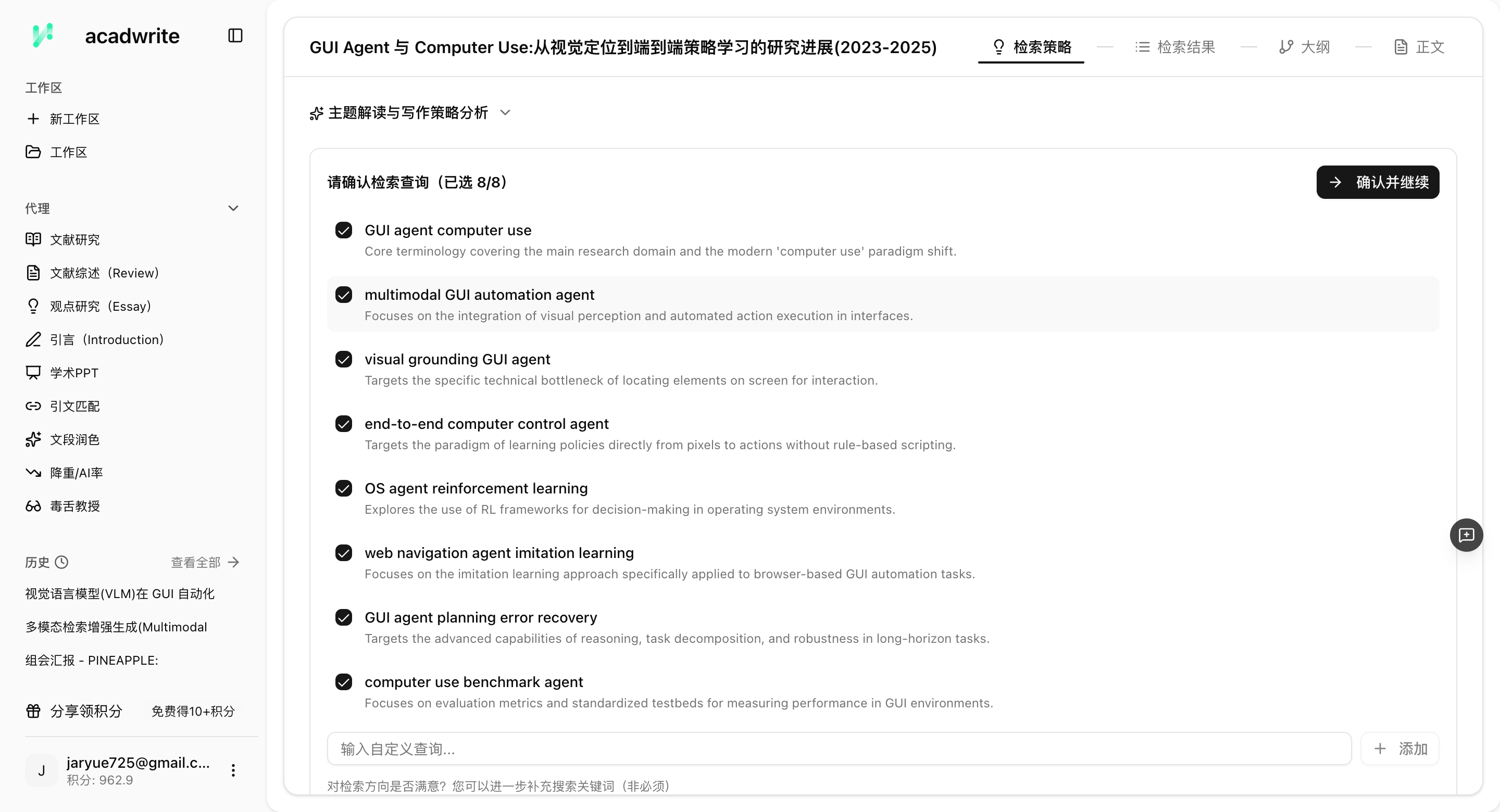
Scientify's agent plans steps, searches and reads sources, writes and runs code, and decides what to do next from intermediate results inside an isolated cloud computer. Tasks continue after your local computer is offline; researchers return to inspect evidence, methods, and deliverables.
- Decompose and advance a complete goal autonomously
- Run real data processing, scientific computing, and visualization code
- Preserve sources, inputs, parameters, errors, and intermediate outputs
- Deliver inspectable, reproducible assets that remain editable
Frequently asked questions
How do I verify a research agent's results?
Check that each result opens and each summary leads to a page or paragraph. Unlocatable content cannot be used directly. For important conclusions, verify the population, method, and applicable conditions in the paper.
Can research agents handle niche or interdisciplinary topics?
Ask the agent to expand terminology across fields, then have a knowledgeable researcher screen it. Niche areas may require more databases and citation tracking, plus manual checks for missing terms.
Which tasks still require a researcher?
Researchers define questions, select materials, judge evidence quality, interpret results, and carry academic responsibility. Agents fit bounded tasks such as retrieval, organization, drafting, and formatting.
How does Scientify support this workflow?
Scientify's agent plans, searches, reads files, runs code, and analyzes results inside an isolated cloud computer. It preserves sources, inputs, parameters, and intermediate outputs and continues after your local computer is offline. Researchers verify critical conclusions and the final delivery.
Continue reading
Start with One Clearly Bounded Research Task
State the goal, constraints, and deliverables, attach files when needed, and inspect the agent's sources, code, parameters, and results.