
Research methods / Literature review
The complete AI literature review workflow: from one question to an editable draft
Stop opening and summarizing papers one at a time. Split the research question into parallel search branches, then move papers, evidence, outline, and prose through one structure.
In this guide
The slow part of a literature review is not sentence writing. It is switching between search, download, reading, classification, and citation. An AI-native workflow defines the final structure first and processes sources in parallel.
You can follow the workflow manually or give the complete task to a cloud research Agent. The tables and task instructions below are reusable.
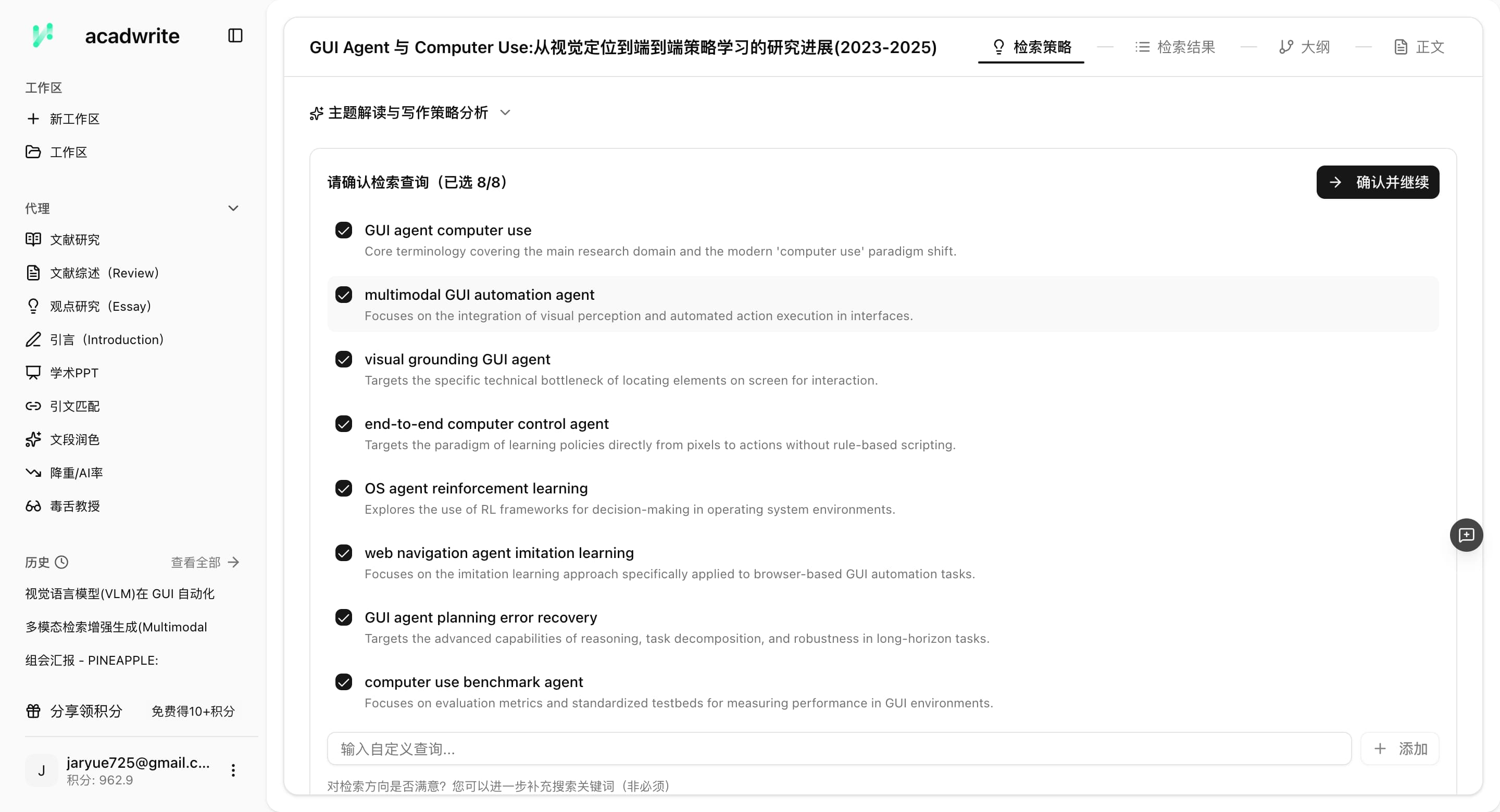
Step 1: Split the topic into questions that can be searched in parallel
Write down the research object, variables, methods, and application contexts. Each becomes an independent search branch that is merged later.
| Branch | Question to answer | Search direction |
|---|---|---|
| Concept and scope | How is the topic defined? | Definitions, taxonomy, boundaries |
| Main methods | What methods are used? | Models, experiments, data |
| Results and debates | Where do findings agree or differ? | Comparison, limitations, conflicts |
| New directions | Where is recent work moving? | New methods, data, settings |
Step 2: Build a query for each branch
Do not search only the exact phrase in your paper title. List synonyms, abbreviations, broader concepts, and method terms, then combine them into several queries.
(large language model OR LLM OR foundation model)
AND (literature review OR evidence synthesis)
AND (workflow OR automation OR agent)- Give each query one branch instead of placing every concept in one long string
- Include common abbreviations and alternative terms
- Use vocabulary from relevant results to expand the second search round
Step 3: Build the paper pool before close reading
The pool completes downloading, deduplication, and screening in one place. Later reading stays inside this set instead of repeatedly returning to search results.
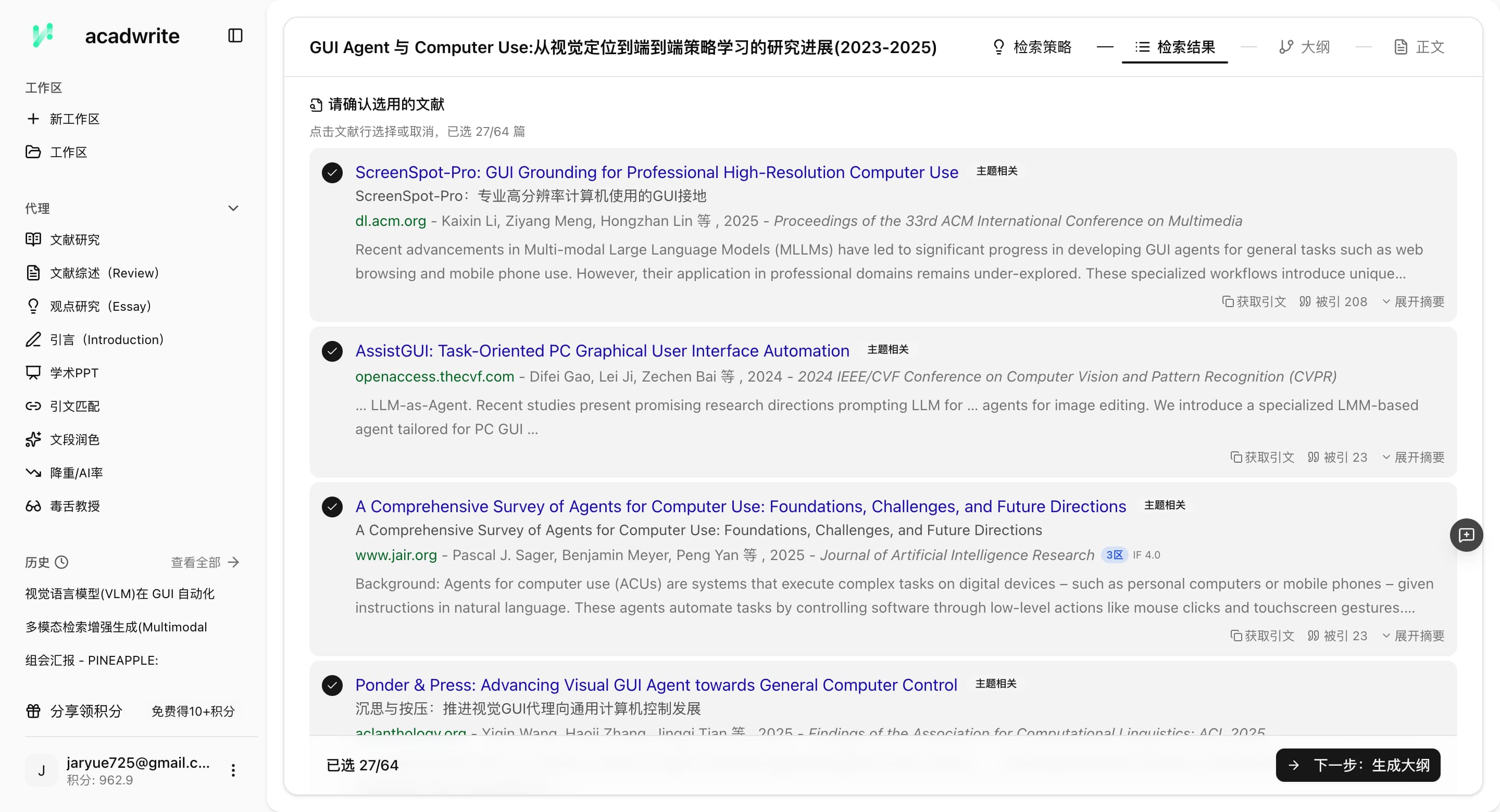
Step 4: Extract only information the review will use
Extract the same fields from every paper first, then decide which papers require full-text reading based on the review structure.
- 1Screen quicklyUse title, abstract, and conclusion to decide whether a paper enters the pool.
- 2Extract consistentlyCapture question, method, data, main findings, and limitations.
- 3Group by themePlace papers under methods, findings, debates, or applications.
- 4Read key papersRead full texts for definitions, central methods, and major debates.
Step 5: Replace isolated summaries with an evidence table
Organize information by the paragraph you will write. One row can contain several papers, and one paper can support several themes.
| Theme | Papers and sources | Claim for the draft | Target section |
|---|---|---|---|
| Tool use | Boiko et al., 2023 | An LLM Agent can combine web and documentation search, code execution, and experimental automation | Tool-augmented Agents |
| End-to-end execution | Lu et al., 2024 | One workflow can generate ideas, write code, run experiments, plot results, and draft a paper | Research workflow automation |
| Cross-domain foundations | Zhang et al., 2024 | Scientific LLMs span disciplines and modalities, while datasets and evaluation methods remain domain-specific | Models and tasks |
Short synthesis: research Agents are moving from isolated answers to continuous execution
Scientific LLMs now support more than text generation. Zhang et al. surveyed over 260 scientific language models spanning text, molecules, proteins, and multiple discovery tasks[1]. These models provide domain capabilities and task interfaces for research Agents, although training data and evaluation still differ across disciplines.
The central change is access to external tools. Coscientist combined web search, documentation retrieval, code execution, and laboratory automation to plan and optimize chemistry tasks[2]. The AI Scientist connected idea generation, code writing, experiment execution, plotting, and paper drafting in one workflow[3]. Together, these systems suggest that efficiency gains come from reusing sources and outputs across steps, rather than generating a longer answer in one pass.
References
- [1] Zhang et al. A Comprehensive Survey of Scientific Large Language Models and Their Applications in Scientific Discovery. EMNLP 2024.
- [2] Boiko et al. Autonomous chemical research with large language models. Nature 624, 570–578 (2023).
- [3] Lu et al. The AI Scientist: Towards Fully Automated Open-Ended Scientific Discovery. arXiv:2408.06292 (2024).
Step 6: Generate the outline from evidence, then draft with citations
Each heading answers one question and lists the evidence and citations it will use. Drafting no longer requires searching for papers again.
- 1.Scope and research object
- 2.Main categories of existing methods
- 3.Data and experiments used by each category
- 4.Shared findings and differences
- 5.New directions in recent work
- 6.Questions that remain open
Chat, literature tools, and a cloud Agent
| Workflow | Best for | Manual handoffs still needed |
|---|---|---|
| General chat | Discussing topics and revising local text | Search, download, file organization, citation insertion |
| Literature search tool | Search, summaries, single-paper Q&A | Batch downloads, cross-paper tables, complete delivery |
| Cloud research Agent | Search branches through paper pool, evidence table, and draft | You provide scope, source files, and deliverable requirements |
Keep intermediate files with the final review
Keep the paper list, evidence table, and citation files alongside the prose so future expansion can reuse the work.
Frequently asked questions
How many papers should a review include?
Build a candidate pool from search branches, then select core papers based on length and theme coverage. Do not fix an arbitrary number before searching.
Can I upload my own PDFs?
Yes. Upload PDF, Word, BibTeX, or an existing literature table in Scientify. The Agent combines them with newly found sources.
Can it output Word or LaTeX with citations?
Yes. State the citation format and request Word, PDF, LaTeX, and bibliography files in the task.
Can I add a new theme later?
Yes. Add a search branch in the same workspace, update the evidence table, and rewrite only affected sections.