
How close is it to my topic?
Check the title, abstract, keywords, and research question, and lower the priority of papers that are only loosely related.
Literature backlogs usually come from an unclear reading order. Rank papers by topic relevance, method value, evidence quality, and writing purpose. Let AI extract key information, then reserve your time for papers that require close reading.
| Priority | Decision rule | Next step |
|---|---|---|
| Essential | Directly answers the central question or determines the method and experimental design | Read in full and record methods, data, conclusions, limitations, and quotable source text |
| Citable | Supports background, definitions, or a local point without changing the central judgment | Read the abstract and relevant sections and save exact page or paragraph locations |
| Needs checking | The title is relevant but the abstract cannot show whether it supports the current claim | Keep the record and return to the full text when the claim is needed |
| Defer | Shares only broad keywords while the population, method, and task are unrelated | Remove it from the current queue but retain the search record |
Check the title, abstract, keywords, and research question, and lower the priority of papers that are only loosely related.
Mark data sources, experimental designs, models, variables, metrics, or case methods that may support your research.
Classify it under theory, methods, applications, controversies, or a timeline.
Record not only the conclusion but the claim it supports and its exact source location.
Inspect sample size, controls, limitations, and applicability so weak evidence does not become a strong claim.
Separate essential, citable, and deferred papers and handle what the current task needs first.
Put search results, supervisor PDFs, Zotero records, and local files together, then remove duplicates and clearly irrelevant material.
Use AI to extract titles, abstracts, questions, methods, data, and conclusions and estimate relevance to the task.
Place papers into review background, method comparison, experimental evidence, case examples, or future work.
For highly relevant papers, read the introduction, methods, experiments, discussion, and limitations and record usable evidence.
Return to the original paper for every conclusion you plan to cite and confirm that it supports the claim.
Scientify's cloud agent reads multiple papers and extracts each research question, method, experiment, main conclusion, and limitation. Review structured summaries before deciding what enters close reading, the literature review, or a group presentation.
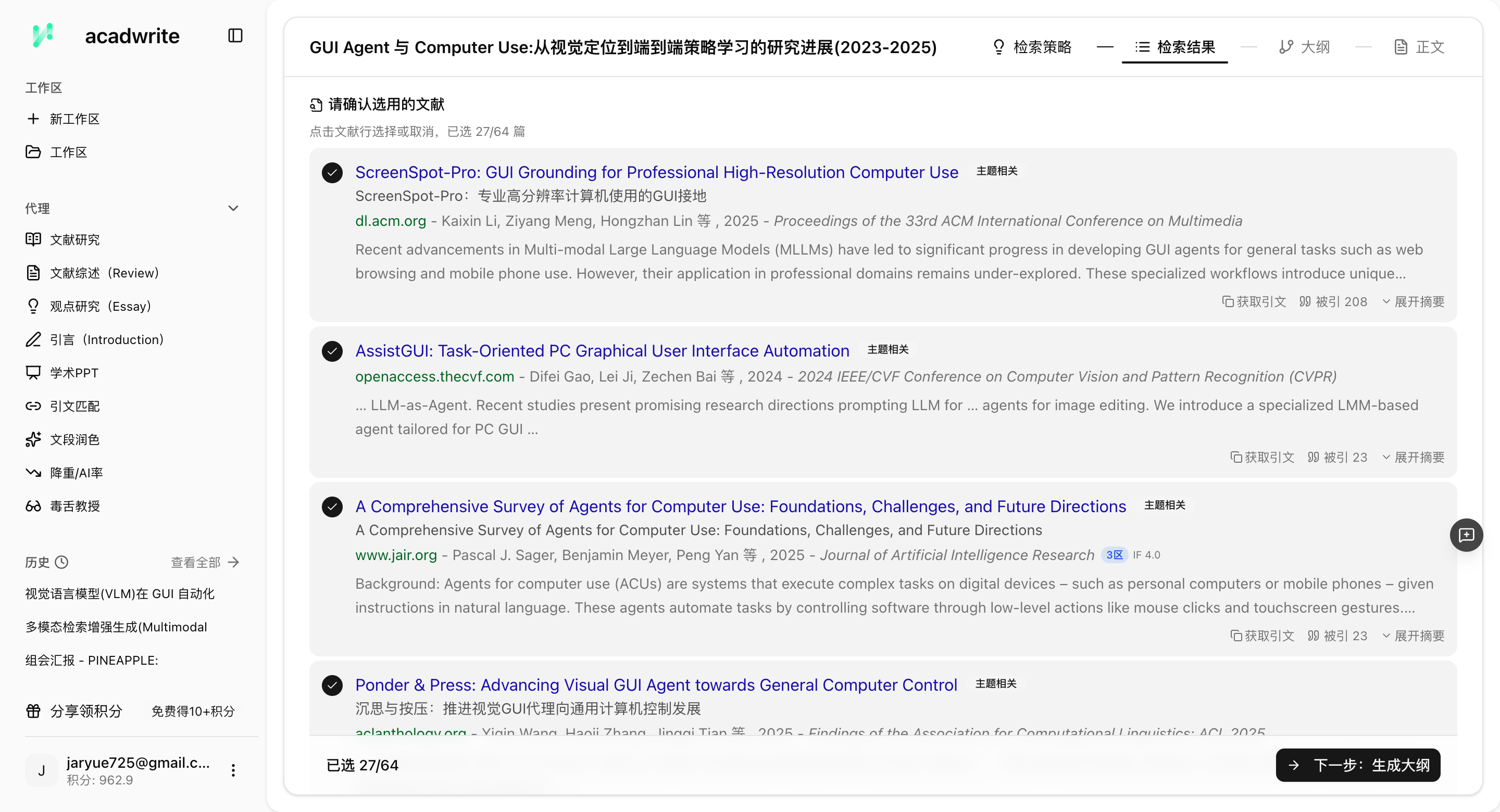
Screen by topic relevance, methodological value, evidence quality, and current purpose, then classify papers as essential, citable, or deferred. Only papers that affect the review structure, research design, or presentation conclusions need close reading.
Yes. AI is suitable for first-pass extraction and ranking. Any conclusion used in writing, presentations, or references must still be verified in the original context.
Scientify organizes multiple papers by research question, method, experiment, conclusion, and limitation for ranking. Selected material can continue into a review, outline, or group-meeting deck.
Upload papers, extract each core method, experiment, and conclusion, then decide which deserve close reading.