
Add missing citations across the full draft
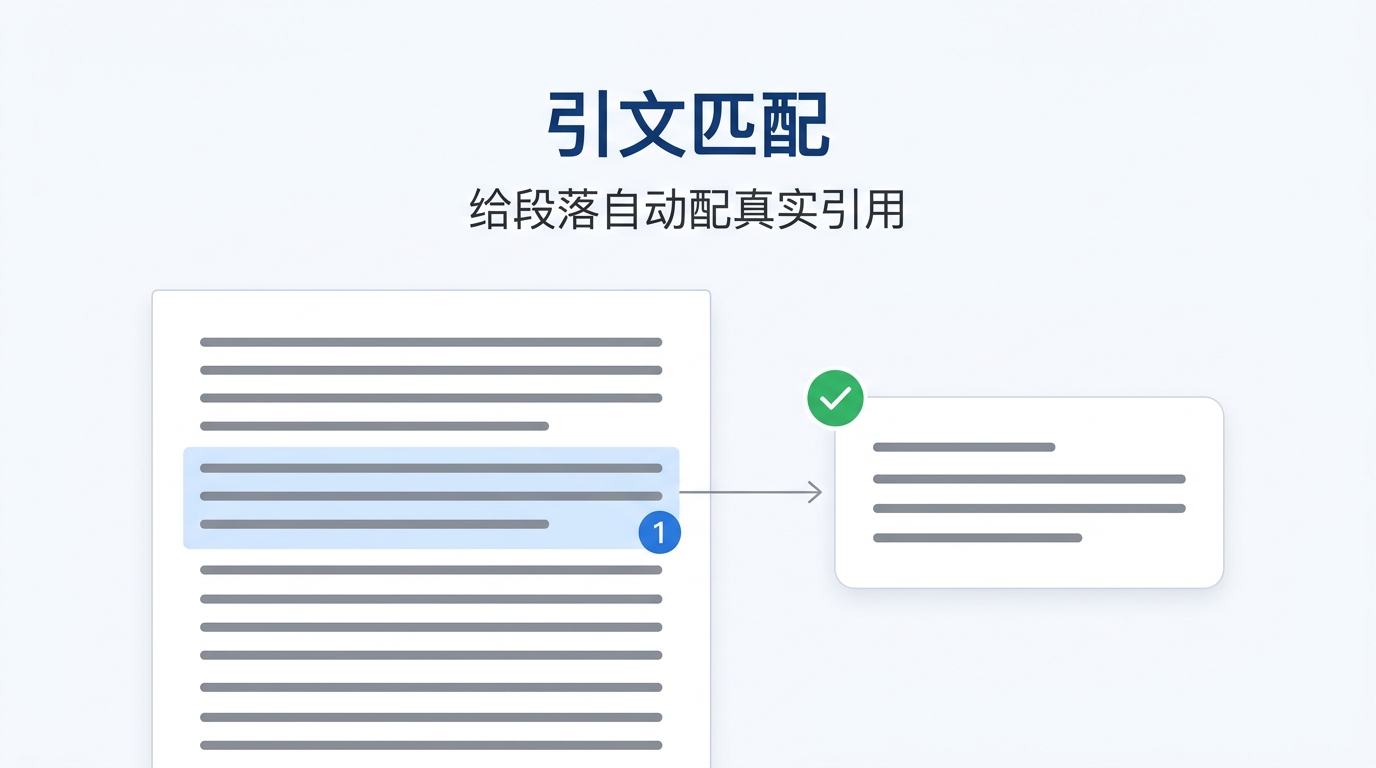
Upload the manuscript. The agent scans passages that need sources, finds papers, inserts citations in bulk, and generates the reference list.
Distinguish the Three Tasks First
Reference formatting
Enter sources you have already selected and output them in GB/T 7714, APA, or another style.
Literature database search
Enter a topic or query and receive candidate publications for the user to screen.
Citation matching
Enter the full manuscript and receive candidate sources, citation positions, and the reference list in bulk.
Scan the full manuscript automatically
Locate passages that need citations and build search queries in bulk.
Download and read source papers
The agent opens candidate papers and extracts content relevant to the current passage.
Organize candidate sources in bulk
Keep search results and manuscript positions together in one workspace.
Add the in-text citation
Insert in-text citations in bulk and generate the reference list at the same time.
How It Works: Four Steps
Locate claims needing citations
Select statements that need sources, including numerical conclusions, others' views, method effects, and factual claims.
Retrieve candidate papers
Turn the sentence's core claim into a query and search for genuine candidate publications.
Download and read the source
The agent opens candidate papers and extracts information needed by the current passage.
Insert and build the list
Add the in-text citation, generate the reference list, and export the paper to Word.
Which Sentences Need Citations—and Which Do Not
Data, others' ideas, methodological origins, and non-obvious factual claims usually need sources. Common knowledge and simple transitions usually do not.
Frequently Asked Questions
Are AI-matched citations real, or can they be fabricated?
Candidate publications come from live search. The agent opens each paper and writes the source information, relevant content, and citation position into the workspace.
How is this different from a reference generator?
A reference formatter processes sources you have already selected. Citation matching scans the manuscript, finds candidate papers, inserts citations, and builds the reference list.
Can it add citations across an already completed paper?
Yes. Put existing paragraphs or the full draft into the editor and run citation matching. It finds real sources sentence by sentence for unsupported claims without requiring you to gather the papers first.
How is it priced?
Citation matching has a fixed charge of 5 credits per paper. See the credits page for details.
How do I export matched citations?
Confirmed sources are inserted at the relevant positions, the reference list is generated in sync, and both can be exported with the draft to Word.
Related Resources
Complete in-text citations and the reference list together
Upload the draft and let the agent find sources, insert citations in bulk, and standardize the reference list.